How We Increased Our Client's Production by 5X
Overview
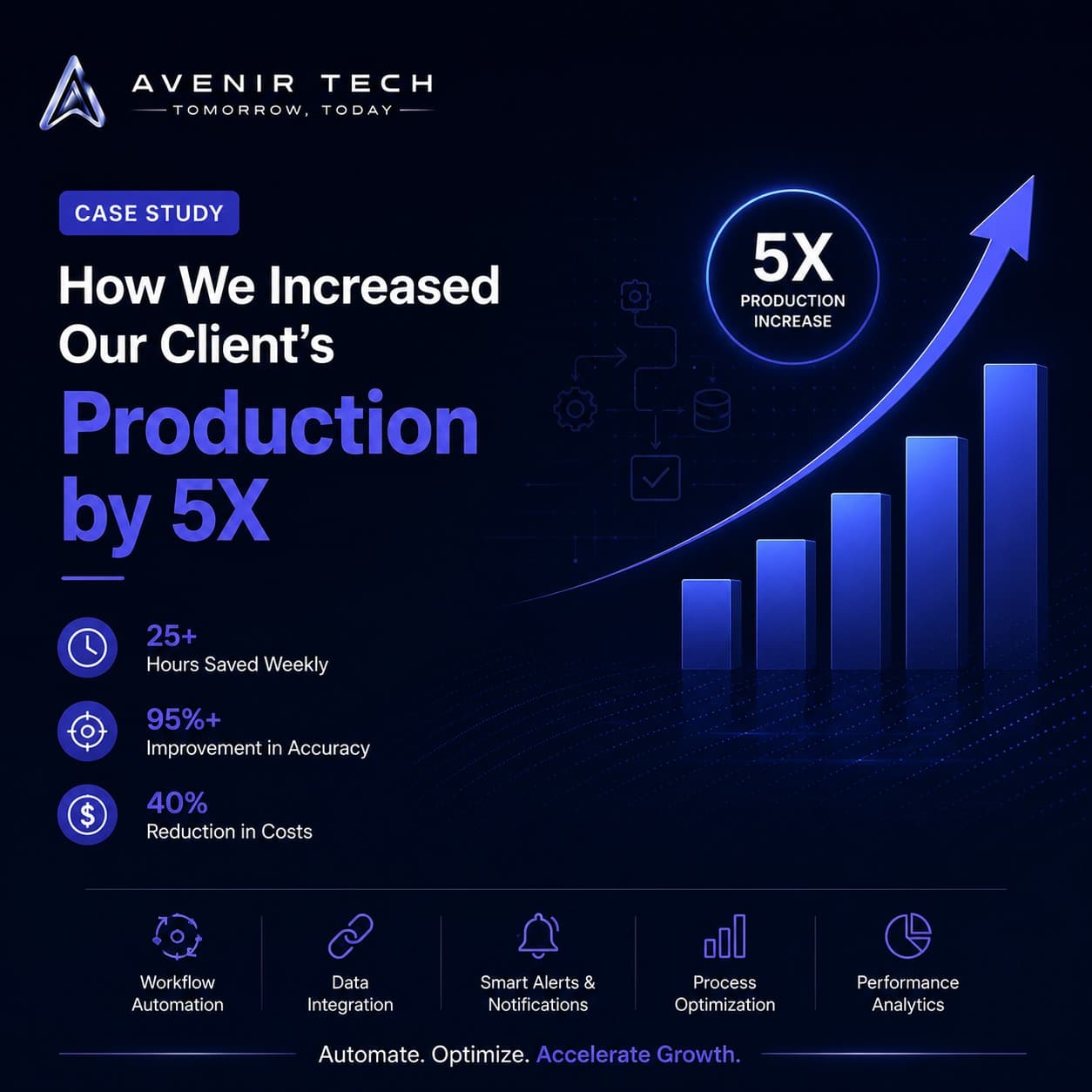
Every business has manual work — that alone isn't the problem. The real problem is everything happening before and after the work itself: repetitive clicking, copy-pasting between systems, manual checks, and status updates nobody has time to send. These invisible steps quietly consume the hours a team needs for the work that actually moves the business forward. This case study breaks down how Avenir Tech partnered with a growing client to diagnose exactly where their workflow was leaking time and money, and how a custom, end-to-end automation solution helped them achieve a 5X increase in production, 25+ hours saved every week, 95%+ improvement in data accuracy, and a 40% reduction in operational costs, all within 90 days.
The Challenge
Our client came to us at a familiar inflection point. Demand was growing and the team was talented and hardworking, but growth had started to plateau — not from a lack of ambition or effort, but because of the system the team was operating inside. Operations were run largely on manual processes: spreadsheets updated by hand, information passed between tools without real integration, and reporting that depended on someone remembering to compile it. When we audited their operations, four core issues surfaced consistently:
25+ Hours a Week Lost to Repetitive Tasks
Team members repeated the same manual processes — data entry, file transfers, status checks — across systems that didn't talk to each other. Individually each task took minutes; collectively, across the team and the week, it added up to over 25 hours of lost productive capacity.
Inconsistent Data & High Error Rates
Manual entry and re-entry across different tools let small errors creep in constantly — mismatched figures, outdated records, duplicate entries. The process itself was too fragile to stay accurate at scale.
Lack of Real-Time Visibility Into Key Operations
Leadership had no live view into day-to-day operations. Reports were backward-looking and built after the fact, so decisions were often made on outdated information.
Limited Bandwidth for Strategic Work
Skilled team members spent most of their time on operational upkeep instead of the strategic, revenue-generating work they were hired to do — growth initiatives kept getting pushed down the priority list.
Our Solution
Rather than layering another disconnected tool onto an already strained system, we redesigned the client's workflow from the ground up: removing unnecessary clicks, eliminating repetitive tasks that added no value, connecting systems so information moved automatically, and simplifying the entire process end-to-end rather than patching individual symptoms. This led to a custom automation solution built around five interconnected pillars.
Workflow Automation
We mapped every step of the client's core operational processes and identified which required human judgement versus which were purely mechanical. Mechanical steps were automated, turning multi-step, multi-person processes into workflows that ran automatically in the background.
Smart Alerts & Notifications
Instead of team members manually checking systems for updates, we built automated alerts that surfaced the right information to the right person at the right time — flagging exceptions or delays, and staying silent otherwise.
Data Integration
We connected the client's previously siloed tools into a single, unified flow of data. Information entered once now flows automatically everywhere it's needed, eliminating the duplicate entry that had been the biggest source of inconsistency and error.
Process Optimization
Beyond automating existing steps, we questioned whether each step needed to exist at all. Redundant approvals, unnecessary handoffs, and outdated checks were streamlined or removed entirely.
Performance Analytics
We gave leadership a real-time performance dashboard — a live, always-current view into the metrics that matter, replacing after-the-fact reporting with instant visibility.
The Results
| Metric | Result | What It Means |
|---|---|---|
| Production Speed | 5X faster | Work that once took days now takes hours |
| Time Saved | 25+ hours every week | Reclaimed capacity equivalent to hiring an extra part-time team member |
| Data Accuracy | 95%+ improvement | Manual entry errors virtually eliminated |
| Operational Costs | 40% reduction | Less spent maintaining broken processes |
| Strategic Capacity | More time unlocked | Team redirected toward growth, not admin |
These weren't isolated wins. Because the five pillars of the solution were interconnected, improvements compounded — faster workflows meant more accurate data, which meant more reliable analytics, which meant faster, more confident decision-making across the business. Most importantly, this transformation didn't come at the cost of the team — nobody was replaced. The people already doing great work were finally given the space to focus on it.
Why This Matters
It's easy to assume automation simply means adding more tools. In our experience, that's rarely the real fix, and can sometimes make things worse by adding more systems that don't talk to each other. What actually moves the needle is treating automation as a redesign, not an add-on:
- Start with the workflow, not the software.
- Automate the repetitive, not the judgement calls.
- Connect systems instead of stacking them.
- Measure results in hours saved and errors avoided — not just "efficiency" as a buzzword.