How We Helped a Manufacturing Firm Achieve ISO Accreditation with a Custom Document Management System
Overview
For engineering and manufacturing businesses, documentation isn't paperwork — it's the backbone of how work gets done safely, consistently, and compliantly. But for one of our clients, that backbone had become a liability. Engineering drawings, quality records, and change requests were scattered across shared drives, email threads, and physical files, with no single system tracking who changed what, when, or why. Without a reliable way to manage document versions and approvals, the client's path to ISO accreditation — a critical requirement for their industry — was effectively blocked. This case study explains how Avenir Tech designed and built a custom Document Management System (DMS) that brought every engineering and quality document under one roof, with the version control, approval workflows, and audit trail needed not just to pass an ISO audit, but to run the business with real confidence in its own records.
The Challenge
Before working with Avenir Tech, the client's document control process was held together manually — and it was starting to show. As the business grew and audit requirements tightened, four core issues consistently stood in the way:
Engineering & Quality Documents Scattered Across Systems
Drawings, specifications, work instructions, and quality records were stored across shared drives, local folders, and email attachments, with no single, authoritative location for any of it.
No Reliable Version Control
When a document was updated, there was no guarantee everyone was working from the latest version. Outdated drawings and specifications regularly ended up on the shop floor, creating real operational and compliance risk.
No Formal Approval or Change Process
Document changes and approvals happened informally — over email, in conversation, or simply by someone editing a file directly — with no consistent record of who approved what, or when.
ISO Accreditation Out of Reach
ISO standards require demonstrable, auditable control over documentation: versioning, approvals, and change history. Without a system capable of producing that evidence, the client's accreditation efforts kept stalling before they could even reach audit.
Our Solution
Avenir Tech designed and built a custom Document Management System from the ground up, tailored specifically to how engineering and quality teams actually work — and to the exact evidence ISO auditors need to see. Rather than adapting a generic off-the-shelf tool, we built a system around the client's real document types, approval chains, and compliance requirements.
Centralized Engineering Document Control
Every engineering drawing, specification, and technical document now lives in one secure, searchable system, replacing the scattered mix of shared drives and local files with a single source of truth.
Centralized Quality Document Management
Quality records, work instructions, inspection reports, and procedures are managed in the same unified system, ensuring quality documentation is always current, consistent, and easy to locate during audits.
Inbuilt Version Control
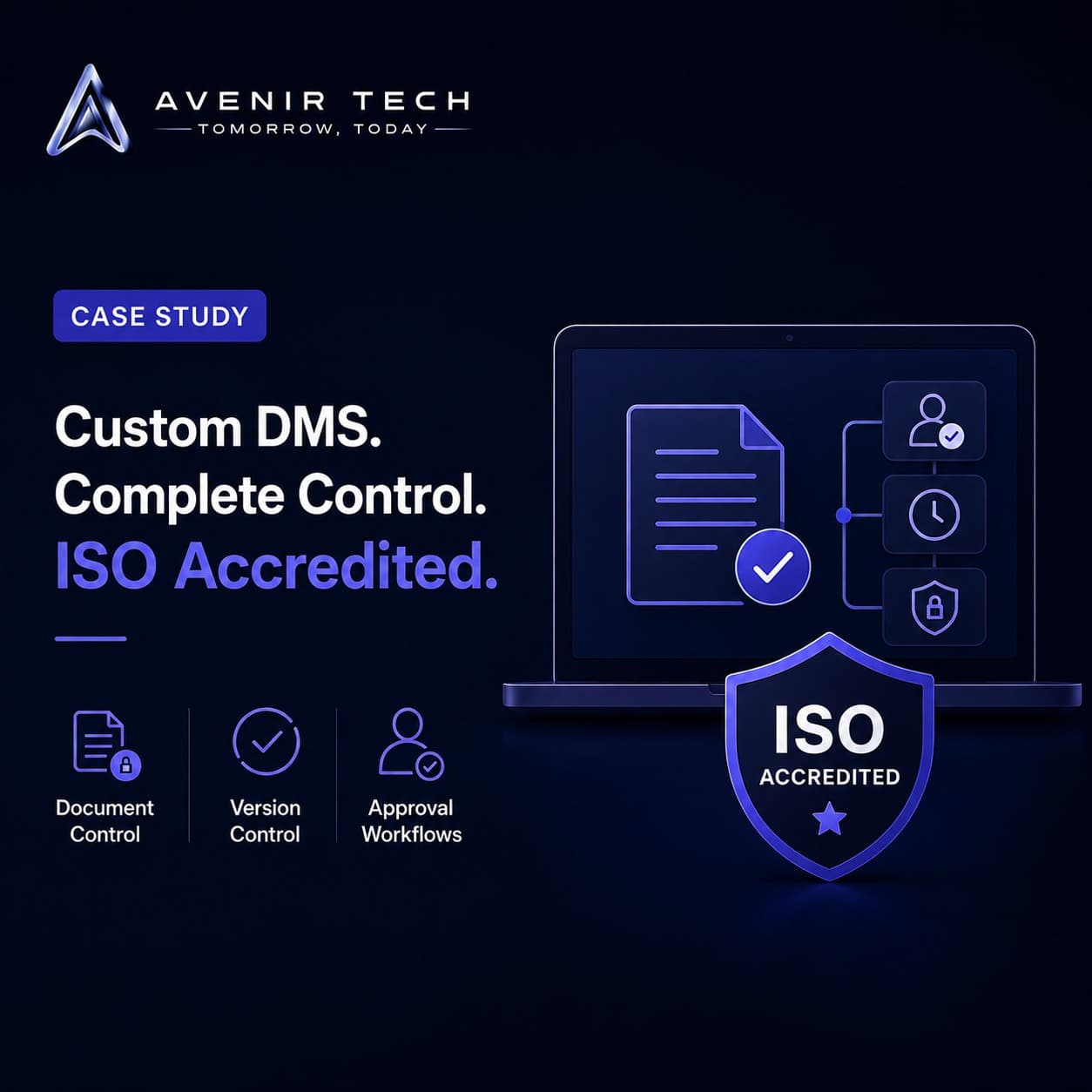
Every document change automatically creates a new, tracked version — never overwriting history. Teams always work from the current approved version, while a full version history remains available for reference or audit at any time.
Formal Approval Management
Documents move through configurable, role-based approval workflows before becoming official. Every approval is time-stamped and attributed, creating a clear, defensible record of who signed off on what.
Structured Change Management
Change requests follow a formal, trackable process from proposal through review to implementation, replacing ad-hoc edits with a controlled workflow that captures the reason for every change.
Secure On-Premise Deployment
The entire system runs on the client's own on-premise infrastructure, keeping sensitive engineering and quality data fully within their control rather than hosted on third-party servers — a requirement in industries where data sovereignty and security are non-negotiable.
The Results
| Metric | Result | What It Means |
|---|---|---|
| ISO Accreditation | Achieved | Full accreditation reached with audit-ready documentation |
| Document Control | Fully centralized | Engineering and quality documents unified in one system |
| Versioning | 100% automated | Every change tracked with no manual version management |
| Approvals | Fully traceable | Every sign-off recorded with time-stamped accountability |
| Data Hosting | 100% on-premise | Complete control and security over sensitive data |
The most significant outcome was one the client had been working toward for years: ISO accreditation. With a system finally capable of producing clear, auditable evidence of document control, versioning, and change history, the accreditation process moved from stalled to complete. But the benefits extended well beyond the audit itself. Teams no longer second-guess whether they're looking at the current version of a drawing or procedure. Approvals happen through a consistent, accountable process instead of scattered emails. And because the entire system runs on-premise, the client retains full ownership and control over some of their most sensitive engineering and quality data.
Why This Matters
Document control is often treated as a compliance checkbox — something to satisfy an auditor once and forget about. We approach it differently. A well-built document management system isn't just about passing an audit; it's about giving engineering and quality teams a system they can actually trust every day.
- Build around real document types and approval chains, not generic templates.
- Make version control automatic, not something teams have to remember to do.
- Treat every approval and change as a record worth keeping, not just a step to complete.
- Respect data sovereignty — for regulated industries, on-premise control matters.